Please pardon me, I’m trying to figure out how to say this without being offensive. Then again, offense is so subjective, so here goes…
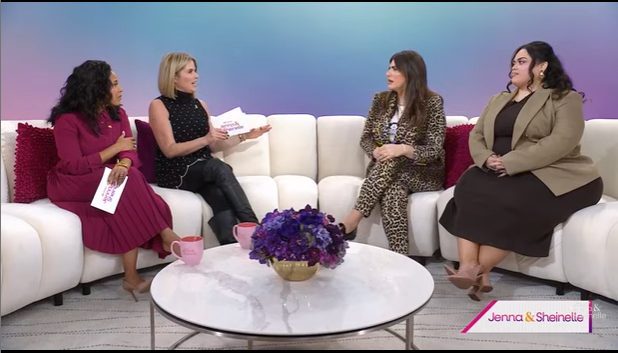
Recently I was watching one of my favorite shows, Jenna & Sheinelle. They had this body positivity segment, I guess you could call it, where they featured women from the body positivity movement sharing why so many of those who were once vocal about being fat and fabulous are now reaching for GLP-1s to try to un-big their backs.
As a fellow fat person, I’ve always said the body positivity message was misguided. I can recall many of these women – I say women, because I personally don’t remember any men at the forefront of the movement – talking about just because you’re big doesn’t mean you’re not healthy and I work out too – you know, on and on with stuff like that – basically, trying to correlate themselves with women of healthier body weights.
My main problem with the body positivity messaging was that it made it seem like being overweight was just another physical feature to be celebrated like being short, or having brown hair, or having nice legs, instead of the ailment that it actually is. I never heard them talking about the dangers associated with obesity. Instead, they were constantly quoting stats like most American women are a size 14. Or they’d lament about how stores didn’t carry their sizes and they were being shut out of the fashion industry. I believe that’s what you call a classic red herring.
The earliest I can remember size-inclusivity becoming a thing was in the 90s when a model named Emme came on the scene. Dubbed the first plus-sized supermodel, she was a size 14 as opposed to the typical size 2-6 that models were back then. However, I think the movement really began to take off with the rise of the digital age where heavy-set women left off the pages of top magazines could create their own photoshoots and post them on their blogs. That, coupled with the advent of social media, in particular YouTube and Instagram, meant big women didn’t have to wait to be recognized by traditional media, they could showcase themselves. Brands took notice, capitalizing on a whole untapped market of women by using algorithmic segmentation to reach these women without ever disrupting the status quo.
Most of the women I recall being at the forefront of the movement weren’t women who could simply stand to lose 30, 40, or even a whopping 50 pounds. No, these were more like women carrying 100-plus pounds of extra body weight – some of the most dangerous ranges – never mentioning the health factor.
As the movement grew, I remember they used to be on talk shows, news magazines and such showing big people with agility – like big people who could dance, big people doing yoga, the splits and such, as if to say if they could do the things that we normally associate with being skinny, than that must mean they were healthy. And that is not to say that slimmer people or skinny people are automatically healthy. Obviously if someone is skin and bones, they’ve gone in the opposite extreme and need to address their issue as well. Even someone with normal weight could have health issues. But the fact remains that being fat has never been healthy, there are all kinds of studies that show its adverse effects. It’s my personal belief that a lot of these body positive people were being facetious about their health.
Of course, that was then. Now that GLP-1s have come on the scene, I’m seeing a lot of women who once claimed to love their curves (sometimes used as a euphemism for rolls) all of a sudden purporting to be prediabetic, the condition the meds were originally designed for. Now it seems like, the messaging that overweight women can be just as healthy as their normal-sized counterparts is a bygone idea.
That is not to say that some of them are not prediabetic. As a matter of fact, I have no doubt that many of them have had health issues or were teetering on the line of getting there all along. I know firsthand as I’ve had to monitor my own blood pressure and have been told by doctors to exercise more and watch what I eat. Not to mention every time I’m at my heaviest, or I reach a new heaviest, lethargy sets in like a rock sinking to the bottom of the ocean. Like once I hit the 240s during the pandemic, I was literally tired all the time. Then when I hit the 250s after I came back from The Bahamas in 2023, I was just tired for no reason. And that doesn’t even begin to address the mental and emotional toll it takes on you to be big in a society that values being thin.
Before GLP-1s, you never heard about the physical issues – it was all about being fat and fabulous. Now that so many of them are slimming down, I think the truth is they were never as happy with being big as they purported to be. They were not happy with the way they looked, and probably also not happy with the way they felt carrying all that weight around. But in this society, definitely not happy with the way they looked, and they jumped at a chance to shrink the bodies that made them lots of money and icons of the movement.
While the communities these women formed were a welcomed change, might I even add a necessary change, I also think it was irresponsible of them to become that influential and not promote the importance of health while making big bucks hawking the latest plus size fashions.
It’s no wonder that some of their faithful followers now feel forlorn. Perhaps some of them even feel used. But at the end of the day, when it comes to grown ass women, we ultimately have to be responsible for our grown ass selves. That means not being mad at other fat people for not staying fat when they’ve found an easy way out.
And yes, that is how I view GLP-1s – they’re an easy way out. Now obviously I’m no doctor and this is just my opinion that has no scientific backing, but that’s how I feel about it. One of the cruelties about getting fat, at least for me, is that it happened early and without me even thinking about it. Like I was an active participant in it, yet I also wasn’t even trying. I just casually picked up bad eating habits, then before I knew it, I ballooned to a size that made me unhappy and to some extent, unhealthy. I think that’s why so many people have a difficult time losing weight – it’s because the weight, like any bad habit, is so easy to take on and so hard to take off.
Then, of course, there is the dastardly disposition of food. It’s both friend and foe at the same damn time. I mean, that’s been true all my life, but particularly during this last past year when I was so low on money, food was the only thing I could afford to bring me joy. Snacks at the dollar store became my playground. Three-dollar tubs of Great Value ice cream at Wal-Mart never let me down.
As a matter of fact, when I was thinking about writing this piece and I thought about the role food has played in my life over the past year, broken pieces of the chorus from an old 70s song came to mind. The words in my recollection went “you were a friend of mine” something, something “so kiiiinnddd!” The beat, the melody, the instrumentation were all so vivid even though the lyrics were foggy.
It’s funny that that specific song would come to mind because it wasn’t one that I frequently listened to. It wasn’t even one of the ones that I was forced to take in because my mom liked it so much. And yet when I was thinking about my relationship with food, it was this obscure song that popped in my head. Funny how the brain works.
At that point, I was curious to know what this song was. I wanted to hear the whole thing. So, I took the lyrics I had to google, and it came back with Kelly Price’s 90s R&B hit “Friend of Mine.” But that wasn’t it, so I searched again adding that the song was from the 70s. It still came back with Kelly’s song. Google usually comes through when I give it sparse lyrics, but not this time.
Finally, I gave ChatGPT a try and it returned a song called “Please Pardon Me” by Rufus featuring Chaka Khan. “Please Pardon Me?” Why would a song about a friend be titled “Please Pardon Me?” I plugged the title into YouTube to listen to it and be certain, and what do you know – that was it.
“Friend of mine” and “so kind” are exactly how I felt about food this past year. There’s that famous quote, I don’t know where it came from, that no food tastes as good as being thin feels? Well, I can’t speak to the veracity of that, hopefully one day I’ll find out. And by thin I just mean a healthy body weight, not like barely there thin. My point is, I have no doubt that saying may be true, but in the meantime and in between time, that first spoonful of cold, creamy, sweet and buttery (because I was often eating butter pecan, though I also got cookies and cream, cookie dough, and when I wanted to splurge, a pint of Baskin Robbins jamoca almond fudge) goodness on my taste buds in that moment, took away all my pain. I couldn’t stay depressed while eating it. Sure, the depression came rushing right back on in shortly after I finished, but for those moments, however slowly I could consume that ice cream and make it last, it was pure bliss.
And I know I ate it more often than I should have, and I know it’s bad for me physically. Hell, sometimes I even felt a bit bad physically afterward. You know, that feeling you get when you’ve eaten too much, and you feel sluggish and just like you need to rest? It’s also a feeling like…I don’t know, like I feel unhealthy. But still for the temporary joy that it brought me while I was eating it, it was worth it. That’s just how down and out I’ve sometimes felt over the past year. I mean God is great, God is good. I am a tried-and-true believer. But sometimes God be feeling like a figment of my imagination. Sometimes I need something tangible to hold on to, something tangible to get me through – food has been that for me. And that is why I believe so many of these overweight women had a hard time losing weight before the GLP-1s – because they were using food, not simply for nourishment or even enjoyment, they used it to ease the pain.
Currently I’m doing the processed sugar fast Pastor Toure Roberts (PT what they call him) of The Potter’s House called for during the month of March – 25 days down, six more to go. And yes, it is my goal, going forward, to consume sweets more sparingly, but I will never give them up completely. As a matter of fact, I’m looking forward to having more when I come off this fast.
At the end of the day, I know that eating bad-for-you food is, well, bad for me. Still, I don’t care what nobody say, that ice cream truly was a friend of mine, and I’m grateful for it.
Turns out, those lyrics I recalled from the song weren’t completely correct. Instead of “you were a friend of mine” they’re actually “… you look like a friend of mine. And it’s seldom you find a face that’s so kind.”
As I listened to the song, I was pleasantly surprised to discover why that title was so fitting. Chaka wasn’t singing about a friend of hers, she was singing about a stranger who reminded her of a friend of hers. A stranger with a kind face seldom found. Discovering that little tidbit about the song made it feel even more apropos to my relationship with food. Food, in the way I mentioned it moments ago, isn’t really a friend of mine, but in those times when I’m down and out and it brings me comfort and joy it certainly feels like one, looks like one.
After I listened to the song, I googled the lyrics. Sometimes it’s hard to tell what a song is trying to convey just by listening to it. Sometimes it’s also hard to make out the words. Something about this song was so intriguing to me, especially given the way it came to mind. I wanted clarity, so I googled the exact lyrics hoping that reading them would make things clear. Instead, they made it more complex. I discovered that maybe the person described in the song wasn’t a random stranger after all, but possibly someone she used to know — perhaps an estranged lover, an old friend.
Try as I may, after reading the lyrics repeatedly, I couldn’t ascertain, from the way the lyrics were structured, if this person was an actual stranger or someone more familiar.
Finally, I concluded that the actual meaning didn’t matter. It could be whatever I wanted it to be. I didn’t need that answer to enjoy the song.
And that brings me to editing my novella. As you may know, I wrote a book – a novella. Two years ago, after waiting 20 years, I finally attempted to publish it. Then I ran into a bunch of problems I didn’t anticipate, notwithstanding running out of money…well, okay, the running out of money part I was aware of. Anyway, recently, I decided to give this whole self-publishing thing another go, starting with reviewing and editing my manuscript that I got back from the editor two years ago.
You may also know that I did not like that editor’s work and therefore I don’t trust it. That means I’m checking all her corrections that I’m not absolutely certain about with AI before I move forward. This has allowed me to catch a plethora of her mistakes, not only grammatical ones, but the most egregious of them all, stylistic ones. In some of her changes, she essentially adapted my voice to suit her own.
As someone who can be insecure about my writing – hence it’s taken me over 20 years to even attempt publishing this story again – seeing my story marked up like a game play drawn up by a basketball coach for the team’s star shooter to nail a game winner with .03 seconds left on the clock, did nothing for my confidence. If that wasn’t enough, when I consulted AI to check the editor’s work, it would be like, “Yeah girl, that sentence was grammatically correct. That editor don’t know what she talkin’ ‘bout.” Just as I began to breathe a sigh of relief, my confidence slowly rising, it continued, “but your sentence is a bit clunky,” and proceeded to offer several ways I could de-clunk-ify my sentence, shooting my confidence right back down.
Suddenly, I started questioning whether I should rewrite or restructure my sentences. If the clunkiness of it all would be too much for the reader to bear. Then I listened to “Please Pardon Me,” and read its lyrics, and the remnants of my confidence started to bloom.
The ambiguity in that song regarding whether there is one person talking or two, whether the person is a stranger or someone she once knew, oddly enough gave me clarity about my own writing. That’s when I was like fuck it. If I’m a clunky writer, I’m just going to have to be a fucking clunky writer.
In making that decision, I was reminded of a friend of mine – the woman who once wrote a story with crippling insecurity but also abandon. What a pleasure to be reintroduced.
Leave a Reply